ISSN 2097-6046(网络)
ISSN 2096-7446(印刷)
CN 10-1655/R
主管:中国科学技术协会
主办:中华护理学会

中华急危重症护理杂志 ›› 2026, Vol. 7 ›› Issue (8): 972-975.doi: 10.3761/j.issn.2096-7446.2026.08.013

• 急症护理研究 • 上一篇    下一篇

腹主动脉附壁血栓患者髋关节置换围术期新发脑梗死的风险评估及护理

许国萍(), 李丽*(), 来丽红, 胡欢婷, 任英   

  1. 浙江大学医学院附属第二医院护理部 杭州市 310000
  • 收稿日期:2026-03-23 出版日期:2026-08-10 发布日期:2026-08-04
  • 通讯作者: *李丽,E-mail:2517145@zju.edu.cn
  • 作者简介:许国萍:女,本科,副主任护师,E-mail:zrxgp@zju.edu.cn
    作者贡献声明

    许国萍、李丽、来丽红、胡欢婷:研究实施、循证分析、论文撰写;李丽、任英:研究指导;许国萍、李丽:论文修改、经费支持

  • 基金资助:
    浙江省教育厅课题(Y202558163)

Risk assessment and nursing care for a patient with abdominal aortic mural thrombus who developed new-onset cerebral infarction during the perioperative period of hip arthroplasty

XU Guoping(), LI Li*(), LAI Lihong, HU Huanting, REN Ying   

  1. Department of Nursingthe Second Affiliated Hospital of Zhejiang University School of MedicineHangzhou 310000, China
  • Received:2026-03-23 Online:2026-08-10 Published:2026-08-04
  • Contact: *LI Li,E-mail:2517145@zju.edu.cn
  • Supported by:
    Zhejiang Provincial Department of Education Project(Y202558163)

摘要:

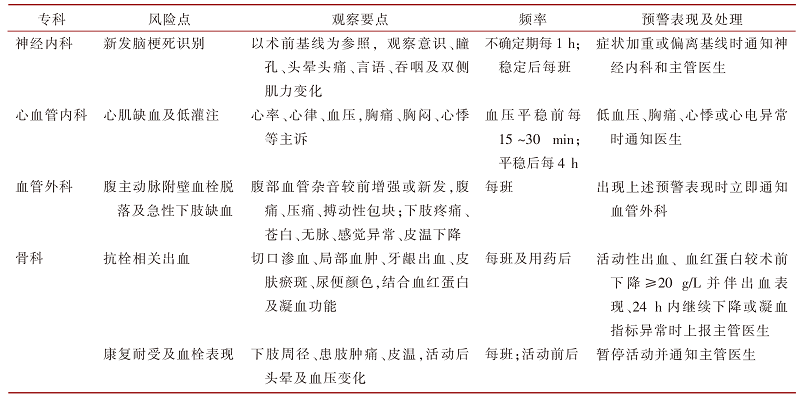
总结1例腹主动脉附壁血栓患者髋关节置换围手术期新发脑梗死的风险预警与清单化护理。患者近期经皮冠状动脉介入治疗后接受左人工股骨头置换术,合并既往缺血性卒中、术前无症状脑梗死灶及腹主动脉附壁血栓,术后第3天头颅磁共振成像提示左小脑新近腔隙性脑梗死、左顶叶新近腔隙性脑梗死考虑。护理重点为四重高危因素显性化交接与术前神经功能基线固定、症状持续期连续神经监测、腹主动脉附壁血栓病灶导向评估、抗栓治疗相关风险监测、多学科床旁交班清单管理与症状耐受下分级康复。患者未出现新发意识、言语、吞咽或肢体功能缺损,住院期间未发生血栓脱落相关表现及出血并发症,术后第6天转至康复机构。

关键词: 腹主动脉血栓形成, 脑梗死, 关节成形术, 置换, 髋, 围手术期护理, 病人交接

Abstract:

This paper summarized risk warning and checklist-based nursing care for a patient with abdominal aortic mural thrombus who developed new-onset cerebral infarction during the perioperative period of hip arthroplasty. The patient underwent recent percutaneous coronary intervention and left femoral head replacement,with previous ischemic stroke,preoperative asymptomatic cerebral infarction,and abdominal aortic mural thrombus. New lacunar infarction in the left cerebellum and suspected new lacunar infarction in the left parietal lobe were reported on postoperative day 3. Nursing care focused on explicit handover of the four high-risk factors and confirmation of the preoperative neurological baseline,continuous neurological monitoring during the symptomatic period,lesion-directed assessment of abdominal aortic mural thrombus,monitoring of antithrombotic therapy-related risks,multidisciplinary bedside handover checklist management,and symptom-tolerated graded rehabilitation. No new disturbance of consciousness,speech,swallowing,or limb function occurred. No thrombus dislodgement-related manifestations or bleeding complications were observed,and the patient was transferred to a rehabilitation institution on postoperative day 6.

Key words: Abdominal Aortic Thrombosis, Brain Infarction, Arthroplasty, Replacement, Hip, Perioperative Nursing, Patient Handoff